I would like to begin by thanking Tony Franks-Buckley for inviting me to write for this site, an offer which I am most happy to accept.
Time flies, hmm? I have chaired meetings of Riverside Writers for the last nine years; and much fun it has been, too. We're a lively, friendly and informal group who meet in West Kirby Library, Wirral - usually on the last Monday of each month unless a Bank Holiday coincides with this, in which case we meet one week earlier. Meetings start at 7.30pm, and after a catch-up of each others' news we share our efforts for that month's group project.
We started running optional group writing projects a few years ago when we felt the need to focus the group on actual writing, rather than just talking about writing. So each month we set ourselves the task of creating a poem or short story using a set theme, location, an interesting photo or an opening sentence, for example. It's ok if a person diverts from the original idea, as the purpose is simply to offer a starting point. The results have been both interesting and fun, and people who have regularly participated in the project have found that they written pieces which they otherwise may not have thought of and, more importantly, their skills with the craft of writing have steadily improved.
Riverside Writers have played host numerous speakers over the years, including Marc Gee (Al's Lads), Jon Mayhew (Mortlock), Colin P Davies (Tall Tales of the Iron Horse, The Bookmole) and Anthony Peake (Cheating the Ferryman). We have also held public readings, sometimes as part of Wirral Bookfest but also independently. Several members have also participated in Wirral's festival of SF/F/H, called Parallel Dimensions, which has attracted writers from across the UK.
In 2012, Riverside Writers published an anthology of original short stories and poetry by our members.
The blurb reads: "Romance, heart-ache,
treachery and death! Eighteen stories and poems inspired by the sea, from a
group of imaginative writers who live surrounded by water on the Wirral
peninsula in England."
The contributors are: Tim Hulme; Andy Siddle; Adele Cosgrove-Bray; Peter Caton; Nikki Bennett; Ruth Ann
Titley.
Seaside Stories (ISBN 9781301150069) is available as a FREE download from Smashwords, where it is offered in a variety of formats.
A second group anthology is already being planned for 2013. This, too, will be produced as an ebook.
If you are looking for a Wirral-based creative writing group, do feel free to come along to any of our meetings. Whether you're a published author or totally new to writing, new faces are always made very welcome at Riverside Writers.
Welcome to Wirral Books, we are here to introduce readers to books based and written on the Wirral. You would be suprised to know just how many Authors their actually are from the Wirral Peninsula and how many books are available. History, Historical-Fiction, Sci-Fi, Fiction and Horror is just some of many Genres available. Featuring Authors such as: Gavin Chappell, Tony Franks-Buckley & Adele Cosgrove-Bray
Showing posts with label West Kirby. Show all posts
Wednesday, 26 December 2012
Wednesday, 12 December 2012
The HitchHikers Guide to the History of the Wirral Coastline
At over 560 pages long, this book will enlighten the reader to the History
of the Wirral Coastline, with a collection of previously unknown materials and
pictures. The collection also offers a reminder of the type of buildings that
swept not only the Wirral but as a country during the Industrial and Victorian
eras. The area boasted many beautiful mansions, houses, public buildings and
gardens which were created to mark the beginning of the modern way of life and
make Britain look the most advanced country and front runner in world during its
Industrial and Post Industrial eras. The area has been blessed with vast amounts
of History and for a small area it excels more than most. Forget Westminster,
the first parliament in the UK was actually on the Wirral, a little area of
Merseyside across the River from Liverpool. It is the nation's capital of Viking
history. Inside this book you will find information of the Viking Ship found in
an area called Meols where Vikings first came ashore onto the Wirral. The name
Wirral is derived from the Gaelic meaning “Wyre Heal” or “Myrtle Corner”. This
is because of the peninsula being heavily forested in the past. The area was
populated by large amounts of deer and other game, so much so that in Medieval
times kings and noblemen used the area for hunting. The emblem of Wirral is the
Wirral Horn. The Horn is a brass tipped hunting horn used by the foresters of
Wirral and is portrayed in many of the Coats of Arms associated with the
peninsula. The horn was given to Alan Sylvester... the first Forrester of Wirral
and has passed through thirty generations to the present owner... the Honourable
Vivian Baring who has leant it to Wirral Museums where it has been on display.
There has been a settlement at what is today known as Wallasey for many
thousands of years. Archaeological investigations at the highest point of
Wallasey... St Hilary's Brow unearthed artefacts dating back to the Stone Age.
The name "Wallasey" is derived from the Gaelic... "Wealas Eye" which roughly
translated means Welshmen's or Strangers' Island. This was due to the fact that
Wallasey could only be reached by crossing water whether it be the River
Birkett, Wallasey Pool, the River Mersey or Liverpool Bay Birkenhead has often
been overshadowed by its neighbour, Liverpool, but it has its own unique and
interesting history. It was at the forerunner of the Parks Movement which the
New York Central Park is designed on that of Birkenhead Park. Birkenhead was
also first place in Europe with a street tramway. To the north of Birkenhead
lies a ridge known as Bidston Hill. The hill lies between Wallasey Pool and the
marshlands that extended from Moreton right the way up to Prenton prior to the
Leasowe Embankment being constructed and Moreton Marshes being drained. The hill
is an extension of the Storeton Ridge that runs down the Wirral as far as
Storeton Quarry, where the Storeton Tramway (an early railway) conveyed the rock
quarried at Storeton to docks at Bromborough Pool (Port Sunlight) on the banks
of the River Mersey. At the north-western corner of the Wirral Peninsula,
approximately one and a half kilometres off the coast, adjacent to West Kirby,
there lies an exposed reef of sandstone. At high water, most of the reef is
submerged. The three parts of the reef that are exposed form the Hilbre group of
islands. Geological evidence suggests that originally, there was one large
island. But, over the years, tide and weather erosion have worn away at the soft
red sandstone to create three islands. The three islands that form the Hilbre
chain of islands are known individually as Little Eye, Middle Hilbre and the
main island of Hilbre itself. West Kirby is a town on the north-west corner of
the coast of the Wirral Peninsula, in the county of Merseyside, England, at the
mouth of the River Dee across from the Point of Ayr in North Wales. To the
north-east of the town lies Hoylake, with the village of Caldy to the
south-east.
To Purchase the Book from Amazon Please Click Here http://www.amazon.co.uk/HitchHikers-Guide-History-Wirral-Coastline/dp/1479363030/ref=la_B008D4XQY2_1_5?ie=UTF8&qid=1355322076&sr=1-5
Retailers can Purchase the Book from Here
CreateSpace
eStore: https://www.createspace.com/4003688
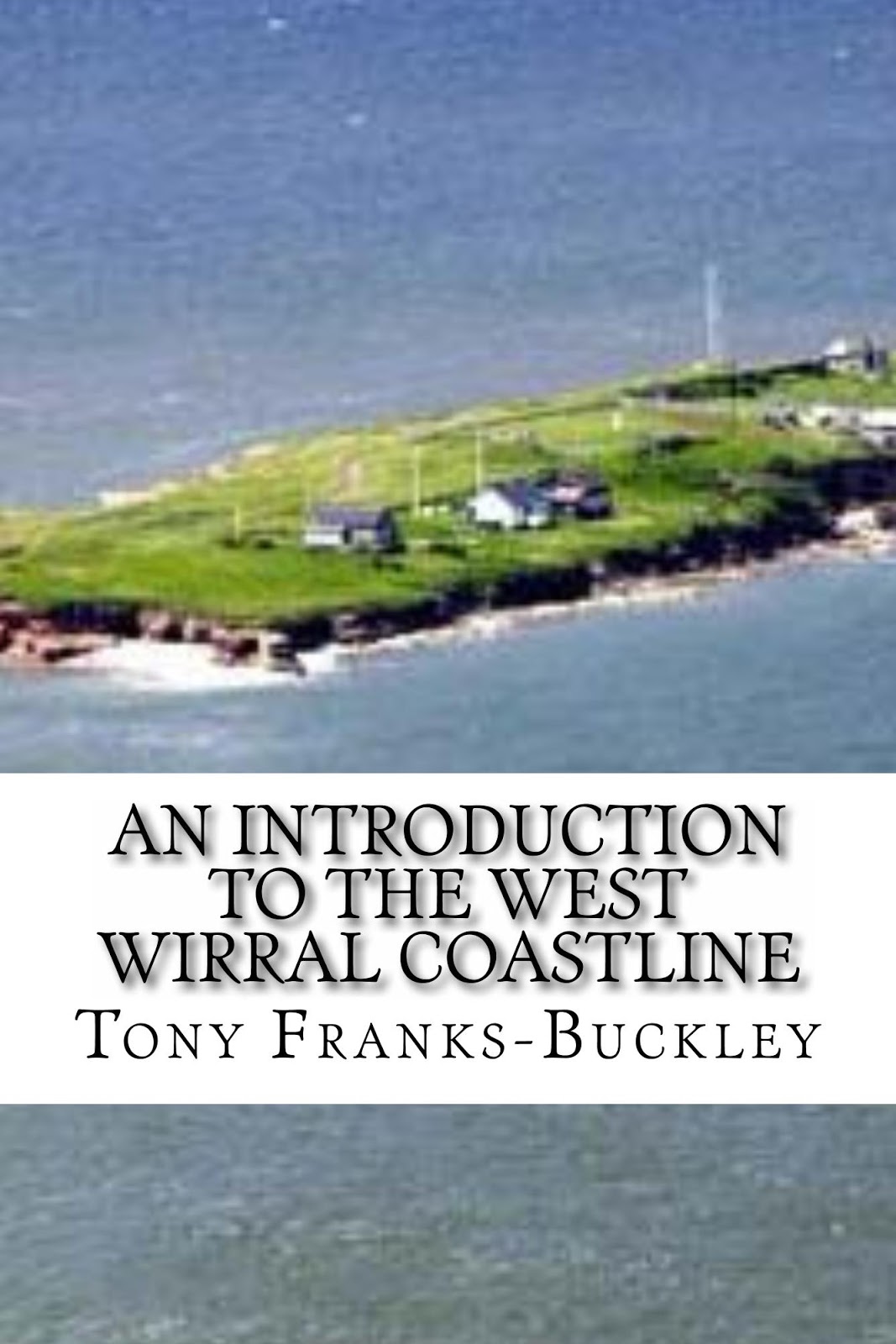
An Introduction to the West Wirral Coastline
At over 160 pages, this book offers an insight into the West Wirral
Coastline during the early years, 18th, 19th, 20th and 21st centuries using
information and plenty of pictures. The West Wirral Coastline is probably the
most naturally beautiful area in the North West of England, offering much
wildlife and species. most notibly the grey seals at Hilbre Island. Over a
thousand years ago Wirral was invaded by the Norsemen and their leagacy can be
read in the local place-names, the -by suffix meaning village in the old Norse
tongue; we still use the term by-law today West Kirby was west of Kirby in
Walea, the old name for Wallasey. The focal point of their settlement was the
site of St Bridget's Church in the old village, although the oldest remaining
part of the building dates back to about 1150, placing it firmly in the Norman
period. The growth of modern West Kirby really began in 1886, when the wonder of
the age of the steam engine - arrived. The speed of travel offered by the
railway meant that it was possible to work in Liverpool during the day but
escape to the cleanermore peaceful and healthier surroundings of this part of
Wirral to live. Developers were not slow to realise this, and the place grew out
of all recognition. The First Edition of the O.S. plan, drawn in 1871, shows
four or five buildings clustered around the corner of Grange Road and Dee Lane.
By the time the Second Edition was drawn in 1897, the village layout south of
Grange Road was almost exactly as we see it today, and by the turn of the
century, just three years later, the shops of the north side were completed. The
population boomed - in 1871 Hoylake and West Kirby together had 2,118 residents;
thirty years later this figure had increased five-fold to 10,991. Down on the
shoreline the Marine Lake is a major attraction for watersports. This was opened
on 21 October 1899, and formerly included an open-air swimming pool. The pool
has gone, but the lake itself has been extended to cater for the growing demand.
This book will also focus on The islands of Little Eye, Middle Eye and Hilbre
which are located at the mouth of the Dee Estuary on the border between England
and Wales. Hilbre is a designated nature reserve and Site of Specific Scientific
Interest, a Special Protection Area, a Ramsar site (a wetland of international
importance), and is a candidate for designation as an European Union Special
Area of Conservation. Last but not least is the beautiful area of Caldy. Caldy
Village was mentioned as Calders in the Doomsday Book. It is situated is on the
west side of the Wirral peninsula and is developed around the old village and
manor which dates from the late 17th century. In 1832 the village was bought by
a Mr R.W.Barton. Development from 1906 to the late 1960s was by way of disposal
of individual plots, in most instances for the purposes of the construction of
single dwellings. The methods of sale continued to constitute a quite effective
way of preserving the special character and nature of the Caldy village, which
was one essentially of a low density area of good quality housing offering a
high environmental quality.
To Purchase the Book from Amazon Please Click Here http://www.amazon.co.uk/Introduction-West-Wirral-Coastline-Peninsula/dp/1479362484/ref=la_B008D4XQY2_1_7?ie=UTF8&qid=1355322076&sr=1-7
Retailers can purchase the Book from here
CreateSpace
eStore: https://www.createspace.com/4003613
Subscribe to:
Posts (Atom)